
Introduction
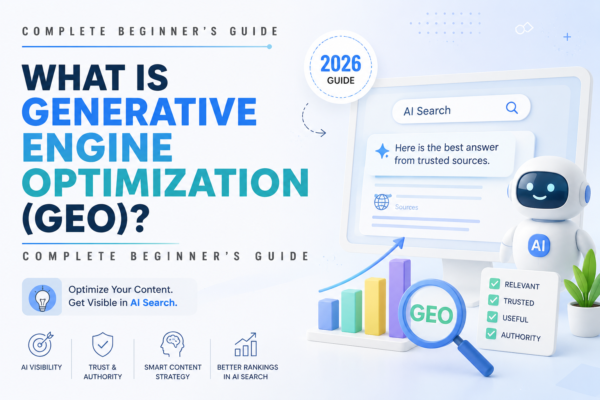
For more than two decades, businesses, bloggers, marketers, and website owners have focused on Search Engine Optimisation (SEO) to improve their visibility on Google and other search engines. The basic goal was simple: rank higher on search engine results pages and attract more visitors.
However, the way people search for information is changing rapidly.
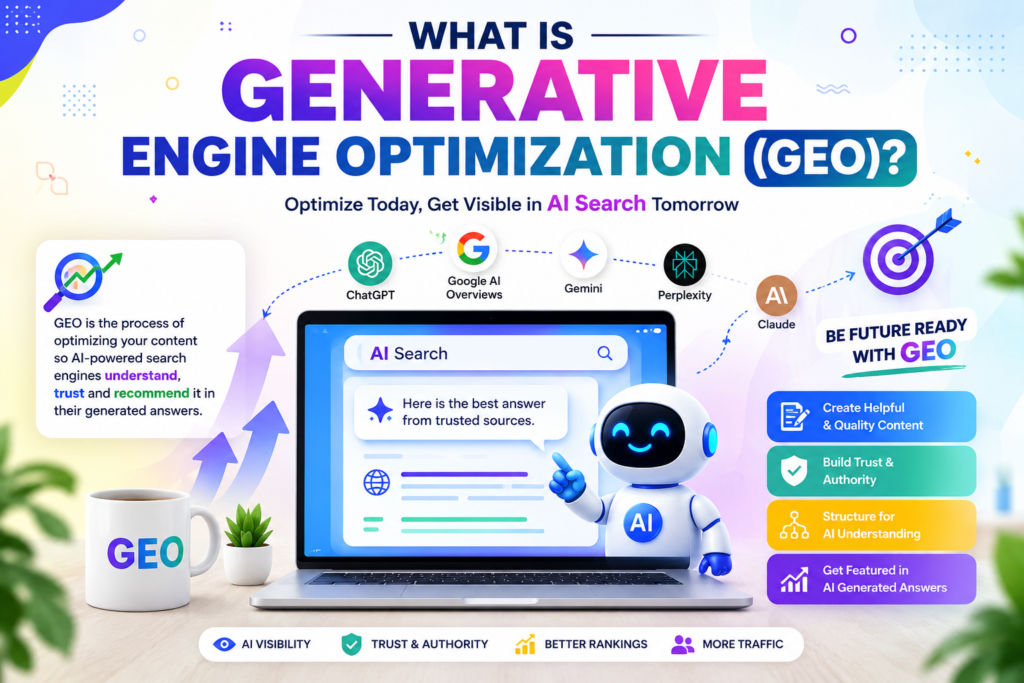
Today, users are increasingly asking questions directly to Artificial Intelligence (AI) tools such as ChatGPT, Google AI Overviews, Gemini, Claude, and Perplexity. Instead of clicking through multiple websites, users often receive direct answers generated by AI.
This shift has created a new challenge for website owners:
How can your content become visible when AI tools are generating answers instead of displaying a traditional list of websites?
The answer lies in a new concept known as Generative Engine Optimisation (GEO).
Generative Engine Optimisation is becoming one of the most important digital marketing strategies for the future. Businesses that understand GEO today will be better positioned to gain visibility, credibility, and traffic in the AI-driven internet ecosystem.
In this comprehensive guide, you will learn what GEO is, why it matters, how it differs from SEO, and how beginners can start optimising their content for AI-powered search systems.
The Current Problem
Traditional SEO has helped millions of websites gain visibility through search engines. However, several major changes are occurring:
Change 1: AI is Becoming the First Source of Information
Instead of searching:
“Best digital marketing course in India”
Users now ask:
“Which digital marketing course is best for beginners in India and why?”
AI tools provide a direct answer.
Change 2: Fewer Clicks
Google AI Overviews often summarise information directly on the search page.
Users may get answers without visiting websites.
Change 3: Conversational Search
People are using natural language questions rather than short keywords.
Examples:
- How can I start digital marketing with no experience?
- What skills are needed for AI marketing?
- Which AI tools should small businesses use?
Change 4: Trust-Based Recommendations
AI systems attempt to identify trustworthy, authoritative, and useful content before generating responses.
This means content quality is becoming more important than ever.
What is Generative Engine Optimisation (GEO)?
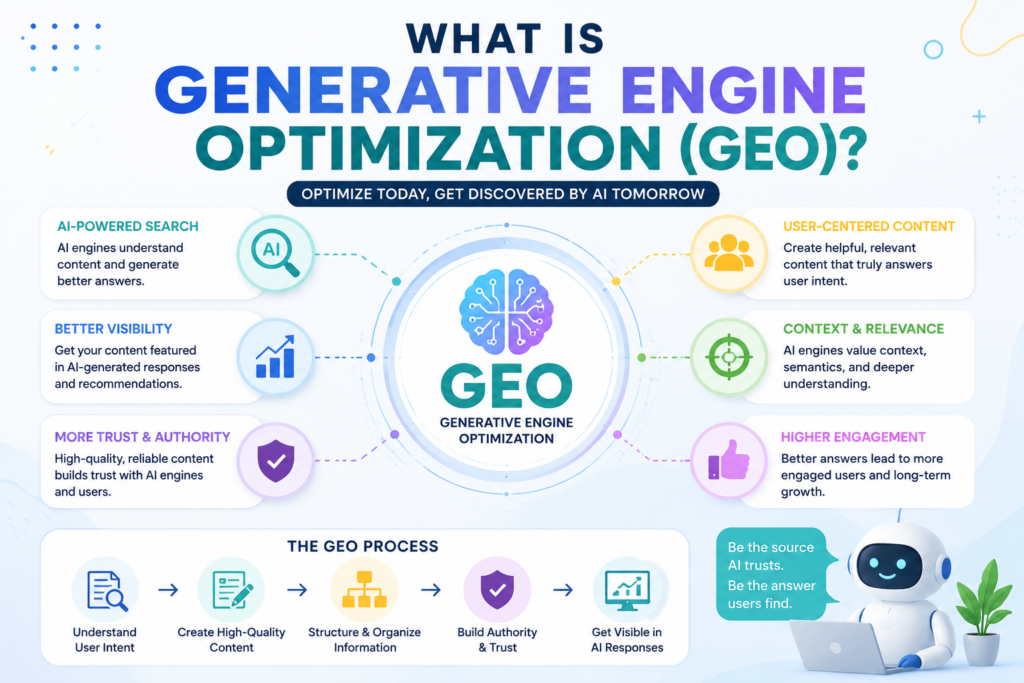
Generative Engine Optimisation (GEO) is the process of optimising content so that AI-powered search systems can understand, trust, reference, and recommend it when generating answers.
In simple words:
SEO helps your website rank in search engines.
GEO helps your content appear in AI-generated responses.
The objective is not only to rank on Google but also to become a trusted information source for AI systems.
Understanding GEO Through a Simple Example
Imagine you own a digital marketing training institute.
Traditional SEO Goal:
Rank on Google for:
GEO Goal:
Become a trusted source when AI tools answer:
“What is the best way to learn digital marketing in 2026?”
Instead of competing only for rankings, you are competing to become a trusted source of knowledge.
Why GEO Matters in 2026 and Beyond
Many experts believe AI search will continue growing rapidly over the next decade.
Several factors are driving this transformation:
Faster Information Access
Users receive immediate answers.
Better User Experience
AI understands context and intent.
Personalized Responses
AI can generate customized recommendations.
Voice Search Growth
Voice assistants rely heavily on AI-generated responses.
Business Visibility
Companies that appear in AI-generated answers may gain significant exposure and trust.
As AI adoption increases, GEO may become as important as SEO.
How GEO Differs from Traditional SEO
SEO Focus
- Keywords
- Backlinks
- Search rankings
- Click-through rates
- Search engine results pages
GEO Focus
- Content quality
- Context
- Authority
- Trustworthiness
- AI comprehension
- Knowledge structure
SEO asks:
“How can I rank?”
GEO asks:
“How can AI understand and trust my content?”
How AI Systems Choose Information
Most AI systems evaluate content based on several factors.
Clarity
Is the content easy to understand?
Authority
Does the website demonstrate expertise?
Accuracy
Is the information reliable?
Structure
Can AI easily identify important points?
Relevance
Does the content answer the user’s question directly?
Freshness
Is the information current?
Content that performs well in these areas has a better chance of being referenced by AI systems.
Key Components of GEO
1. High-Quality Content
Quality is the foundation of GEO.
Your content should:
- Solve problems
- Answer questions
- Provide practical guidance
- Include examples
Avoid writing content solely for search engines.
Write for humans first.
2. Topic Authority
Instead of writing random articles, build content clusters.
For example:
Main Topic:
AI Digital Marketing
Supporting Articles:
- What is GEO?
- SEO vs GEO
- AI Search Optimisation
- ChatGPT Marketing
- AI Content Creation
- AI Visibility
This helps establish authority.
3. Structured Content
Use:
- Headings
- Subheadings
- Lists
- Tables
- FAQs
Structured content is easier for AI systems to interpret.
4. Experience-Based Insights
AI increasingly values practical knowledge.
Include:
- Case studies
- Personal observations
- Industry examples
- Real-world experiences
This makes content more unique and useful.
5. Trust Signals
Trust signals include:
- Author information
- About page
- Contact page
- Privacy policy
- Consistent publishing
Trustworthy websites have an advantage.
Step-by-Step GEO Implementation Guide
Step 1: Understand User Intent
Before writing, ask:
What problem is the reader trying to solve?
Example:
Keyword:
AI Marketing
User Intent:
Learn how AI can improve marketing performance.
Always focus on intent first.
Step 2: Create Comprehensive Content
Instead of writing 500-word articles, create in-depth resources.
Cover:
- Definitions
- Benefits
- Challenges
- Examples
- Tools
- Future trends
Become the complete resource.
Step 3: Answer Questions Clearly
Many AI systems prefer concise answers.
Example:
Question:
What is GEO?
Answer:
Generative Engine Optimisation (GEO) is the process of optimising content so AI-powered search systems can understand, trust, and recommend it within generated responses.
Simple and direct.
Step 4: Build Topic Clusters
Create multiple related articles.
Example Cluster:
- What is GEO?
- GEO Strategy
- GEO Tools
- GEO Case Studies
- GEO Best Practices
- GEO Mistakes
Connect them through internal links.
Step 5: Update Content Regularly
AI systems value freshness.
Review content every few months.
Add:
- New examples
- New tools
- New trends
Step 6: Demonstrate Expertise
Show experience.
Examples:
- Case studies
- Industry insights
- Practical implementation
Expertise builds credibility.
Useful Tools for GEO
ChatGPT
Content ideation and research.
Gemini
Topic exploration.
Perplexity
Research and citations.
Google Search Console
Performance monitoring.
Rank Math
On-page optimization.
Google Analytics
User behaviour analysis.
Ahrefs
Keyword and competitor research.
Semrush
SEO and content planning.
Common GEO Mistakes
Mistake 1
Writing only for keywords.
Better Approach
Write for users.
Mistake 2
Publishing thin content.
Better Approach
Create comprehensive resources.
Mistake 3
Ignoring internal links.
Better Approach
Build topic clusters.
Mistake 4
Using outdated information.
Better Approach
Update regularly.
Mistake 5
Lack of expertise signals.
Better Approach
Show experience and credibility.
Future Trends in GEO
Several trends are likely to shape the future.
AI Search Expansion
More users will rely on AI-generated answers.
Conversational Discovery
Question-based searches will increase.
Personalized Results
AI responses will become more individualised.
Knowledge-Based Content
Educational content will gain importance.
Authority Building
Trusted brands will receive greater visibility.
GEO Strategy for Small Businesses
Small businesses can benefit significantly from GEO.
Focus Areas
- Local expertise
- Educational content
- FAQs
- Customer questions
- Industry-specific knowledge
Consistency matters more than company size.
GEO Strategy for Bloggers
Bloggers should:
- Publish in-depth content
- Create topic clusters
- Build authority
- Share practical experiences
Quality content can compete effectively even against larger websites.
GEO Strategy for Digital Marketing Trainers
For training institutes and educators:
- Create educational resources
- Publish tutorials
- Explain concepts clearly
- Share industry insights
Knowledge-focused content performs exceptionally well in AI-driven environments.
Frequently Asked Questions (FAQ)
What does GEO stand for?
GEO stands for Generative Engine Optimisation.
Is GEO replacing SEO?
No.
GEO complements SEO.
Both are important.
Why is GEO important?
It helps content become visible in AI-generated responses.
Can beginners learn GEO?
Yes.
Anyone creating online content can start implementing GEO principles.
Does GEO require coding?
No.
Most GEO practices focus on content quality, structure, and authority.
Is GEO useful for small businesses?
Absolutely.
Small businesses can compete by creating valuable, trustworthy content.
What is the biggest GEO ranking factor?
High-quality, trustworthy, user-focused content.
How long does GEO take to show results?
Like SEO, GEO is a long-term strategy requiring consistent effort.
Conclusion
The digital marketing landscape is evolving rapidly.
Traditional SEO remains important, but it is no longer the only strategy businesses should consider.
As AI-powered search systems become increasingly popular, website owners must adapt to a new reality where visibility depends not only on rankings but also on trust, authority, context, and content quality.
Generative Engine Optimisation (GEO) represents the next stage in the evolution of digital marketing.
By creating valuable content, building topic authority, organising information effectively, and focusing on user needs, businesses can increase their chances of becoming trusted sources for AI-generated responses.
The future belongs to organisations that educate, inform, and genuinely help their audiences.
Start building your GEO strategy today, and position your website for success in the AI-powered digital world.

About the Author
Ramakant Nevse: RAM Sir is an Electronics & Telecom Engineer, AI & Digital Marketing Trainer, Skill Development Mentor, and founder of M-TEL. With three decades of experience in technology education and vocational training, he helps students, professionals, entrepreneurs, and trainers understand emerging technologies, AI tools, digital marketing, and future-ready skills.